
A voting compass should not tell you how to vote
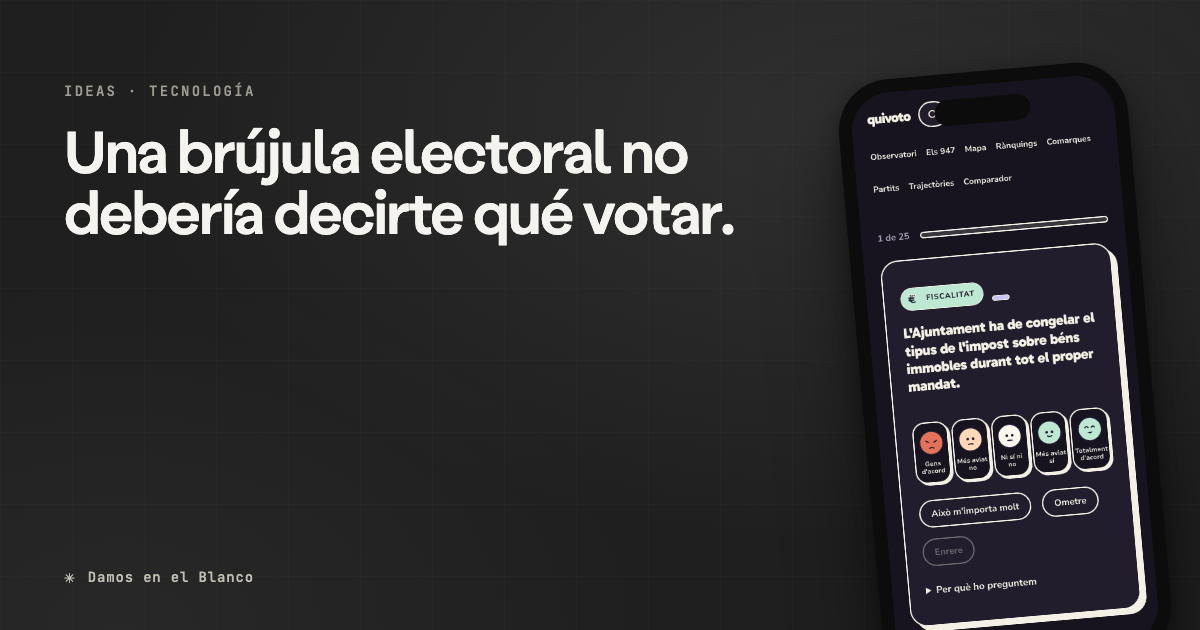
Voting compasses tend to end the same way: you match one party by 82%, another by 67%. The figure looks objective. But before that percentage someone decided what gets asked, how it is worded, how much each topic weighs and what it means for a party to be “in favour”. The number is not the answer. It is the visible tip of a chain of decisions nobody shows you.
Transparency is not about showing the formula. It is about being able to argue with every decision that comes before the result.
Local elections change the question
In a general election it still makes sense to compare big manifestos. In local elections politics gets concrete: whether a lane is closed, whether property tax goes up, whether the council buys housing, whether the library opens in August. Two candidacies under the same party label can vote the opposite way in neighbouring towns. And they do.
That is why quivoto does not ask which party resembles you. It asks which candidacy in your municipality thinks like you on twenty-five local decisions. The compass will open progressively ahead of 23 May 2027, starting with 200 municipalities. But the most important part is already running.
Evidence first. The compass later
Before asking anything, we built an Observatory covering all 947 municipalities in Catalonia: who governs and with whom, the results of the twelve elections since 1979, the full council by name, mid-term changes of mayor, accounts, debt, taxes, turnout and political careers. Every profile is read with the same yardstick, from a village of 150 to Barcelona.
The first compass statements were written by reading council minutes and votes, not by sending out questionnaires nobody answers. And that evidence has limits the product must explain rather than hide: a group may vote against a motion because of how it is worded or who tabled it, not because of what it says. When that happens, the profile says so.
How you build an Observatory of 947 municipalities
With patience and no shortcuts. 39 registered public sources, from the Generalitat’s open data portal to audited budget settlements, each with its period, its processing and its documented limits. 114 fields explained one by one: what they mean, which unit they use, which year they refer to and where to verify them. 1,894 CSV and JSON files under a CC BY licence, so a local journalist can fact-check us without asking permission.
One decision that looks technical and is in fact editorial: each municipality’s file is in long format, one row per indicator. That way, a figure we do not have is simply absent, and that is information, not a hole in a table. And another: no language model generates political positions. Every calculation can be repeated with the downloadable files.
What the 947 already tell us
We opened the Observatory on 26 August, before the compass, because the data was already saying things that never make a headline. In 699 of the 947 municipalities an absolute majority governs. In 62 a coalition deal means the most-voted list is not in charge. In 213 the mayoralty has changed hands since 2023. And 185 councils have no opposition at all: a single candidacy in the chamber; the largest is Gironella, with 5,083 inhabitants. Six villages do not even have a council in the usual sense: they run as open councils, an assembly of neighbours.
| Fact | Municipalities | % of 947 | |
|---|---|---|---|
| Governed by the most-voted list | 874 | 92.3% | |
| Absolute majority | 699 | 73.8% | |
| No outstanding debt | 439 | 46.4% | |
| Mayor changed since 2023 | 213 | 22.5% | |
| No opposition on the council | 185 | 19.5% | |
| Open lists or open council | 177 | 18.7% |
Source: quivoto Observatory, catalunya.csv file (CC BY open data, downloaded 3 September 2026). Original data from the Government of Catalonia, the Spanish Ministry of Finance and the Catalan Ombudsman. The 62 coalition deals and the 11 municipalities without government data are not counted in the first bar.
Then come the records, which is where you realise how different 947 municipalities are once measured with the same yardstick. Four villages had 100% turnout in 2023 — Sant Jaume de Frontanyà, population 25, among them — while Cabanelles stayed at 32.4%. 439 municipalities, almost half, carry no debt; Forès owes €7,718 for each of its 38 residents. Eight councils have been run by the same political force since 1979, L’Hospitalet and Sant Boi among them, while Portbou and Malla have changed winner ten times in twelve elections. Sitges has the most fragmented council in Catalonia and Mieres the most female, with 86% women councillors. In 309 municipalities property tax is calculated on a cadastral valuation older than 1990; in Seva, from 1984.
| Indicator | Municipality | Value | Note |
|---|---|---|---|
| 100% turnout in 2023 | Sant Jaume de Frontanyà, Esterri de Cardós, Fulleda and Granyena de les Garrigues | 100% | Four municipalities of 25 to 174 inhabitants. The lowest: Cabanelles, 32.4%. Catalan median: 65.3%. |
| Outstanding debt per inhabitant | Forès | €7,718/inhab. | 38 inhabitants. At the other end, 439 municipalities (46%) carry no debt at all. |
| Open council | Castell de l'Areny, Fígols, Gisclareny, Savallà del Comtat, Senan and la Quar | 6 municipalities | Decisions are taken in a residents' assembly. Another 171 vote through open lists. |
| Councils with no opposition | Gironella (the largest, 5,083 inhab.) | 185 councils | A single candidacy on the council: 19.5% of Catalonia. |
| Same party in the mayoralty since 1979 | L'Hospitalet de Llobregat, Sant Boi de Llobregat, Malgrat de Mar… | 47 years | Eight municipalities. Catalan median: 7 years. Longest-serving individual mayor: Fogars de la Selva, also 47. |
| Most fragmented council | Sitges | 6.78 effective parties | Laakso-Taagepera index. 305 municipalities have 7 councillors; Barcelona has 41. |
| Most volatile councils | Portbou and Malla | 10 changes | Of winning party across 12 elections. |
| Women on the council | Mieres | 86% | Median: 44%. 228 councils with a female majority (of 734 with data) and 6 with none. |
| Urban property tax (IBI) rate | Blanes | 1.23% | Minimum: 0.40% (Alcanó, Almatret, Bassella…). 309 municipalities apply it on a cadastral valuation older than 1990 (Seva: 1984). |
| Highest average rent | Sant Vicenç de Montalt | €1,637/month | Second: Sant Just Desvern, €1,478/month (the studio's home town). |
| Average payment period to suppliers | Margalef | 1,644 days | Median: 15 days. 3.1% exceed the legal 60 days. |
| Most expensive government per inhabitant | Sant Jaume de Frontanyà | €532/inhab. | The arithmetic of 25 inhabitants: the smallest municipality. The largest, Barcelona, has 1,731,649. |
Source: quivoto Observatory, catalunya.csv file (CC BY open data, downloaded 3 September 2026). Original data from the Government of Catalonia, the Spanish Ministry of Finance, the Catalan Ombudsman and Incasòl. Every figure carries its source on the municipality profile.
And one close to home: the highest average rent in Catalonia is in Sant Vicenç de Montalt, €1,637 a month, and the second highest in Sant Just Desvern, €1,478, the town where this studio is based. For a civic product that is the proof that counts: the starting question — what is happening on my street — has an answer before the compass exists, and anyone can check it with the source next to it.
A result you can open up
When the compass opens, every match will let you go back to the question, see the position attributed to each candidacy, read what was voted and open the source. When data is missing or a candidacy has not validated its answer, it will say so with the same visual weight as a result. Uncertainty is part of the product, not the fine print.
The aim is not to recommend a vote. It is to offer a comparison that helps you ask better questions before deciding.
Real open data, real privacy
Compass answers stay in the browser. No account is needed, there are no cookies and nothing is sent to any server. In a product about politics, data minimisation is not a secondary feature: it is the condition for anyone to trust it. Google Analytics only measures in aggregate, and that is all we know about who comes in.
Explore the quivoto Observatory →
If this interests you
quivoto is one of the studio’s own brands, like eclipsi.info: products we build because nobody was answering the question. The same way of working — sourced data, infrastructure that holds up on the big day, privacy by default — is what we bring to technology projects for clients.
Keep going: the quivoto case study, with what we built and how · eclipsi.info, the eclipse tool · the studio’s free tools · coffee?