
Writing well in Catalan should not depend on a subscription
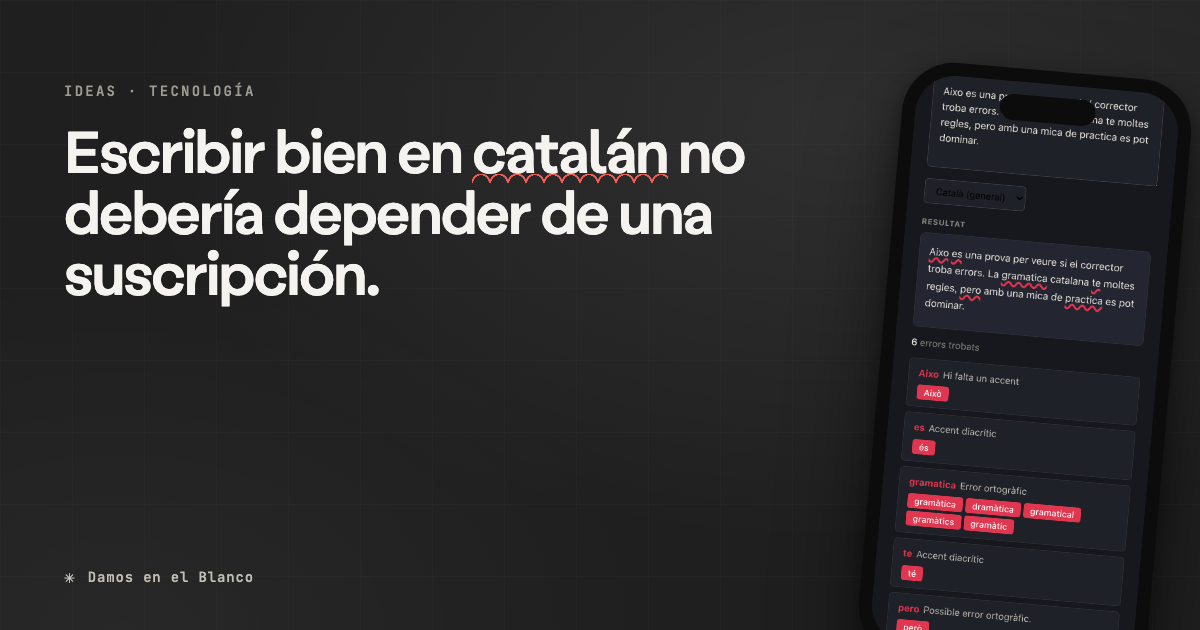
For years, the LanguageTool extension did something quiet and valuable: it underlined Catalan mistakes while you wrote an email, a tweet or a comment. In January 2025 it went Premium-only. A fourteen-day trial and then, unless you pay, the underlines disappear. For anyone writing in Catalan, that was not losing a feature: it was losing the only decent checker there was in the browser.
A basic tool for a language should not be able to vanish with a pricing change.
What broke and what did not
Access broke, not the technology. The LanguageTool engine is still free software (LGPL 2.1) and the Catalan rules — more than 2,500 of them, maintained by Softcatalà and the community — are among the best that exist for our language: they catch agreement errors, weak pronouns, barbarisms and Spanish calques that an ordinary spell checker never sees. What stopped being accessible was the piece connecting that engine to the text box where you write.
Putting the pieces back together
So that is exactly what we did. Corrector Català has three parts, and all three are open.
A server. The free LanguageTool engine running on the studio’s own server, with an API compatible with the official one (v2/check) and a reasonable limit of 30 requests per minute per IP. If you would rather run your own, Docker and nginx get it up in five minutes.
A brand-new Chrome MV3 extension, free forever. It underlines errors in text areas, search boxes, comments and editors such as Gmail, Reddit, X or WhatsApp Web. It works on Chrome, Edge, Brave and Vivaldi. Synced personal dictionary and domain list; automatic dark mode.
A landing page with a live demo. Paste a text and within 0.7 seconds you see the same corrections the extension will make.
What it does (and what it does not)
It automatically detects which variant you are writing in — standard Catalan, Valencian, Balearic or Spanish — and checks in that variant; you can also pin it manually. It does not rewrite your style, it does not paraphrase with AI and it does not suggest “improving your tone”: it checks spelling and grammar, which is exactly what had been lost.
It is also not yet on the Chrome Web Store (the listing is under review) or on Firefox (the build is on its way). In the meantime, installation is manual: download a zip, open chrome://extensions, enable developer mode and load the folder. Five steps, explained on the website.
What we learned from Manifest V3
Building an extension “like the old one” is no longer possible: Manifest V3 removed persistent background pages. In their place there is a service worker that wakes up, batches what you have typed, waits for you to stop and sends it in one go, with a cache so the same text is never checked twice. And no browser lets you underline inside a textarea: where it exists we use the CSS Custom Highlight API; where it does not, a mirror layer placed exactly over the text. None of this is visible. All of it is what makes the visible part work: a wavy line under the wrong word.
Privacy you can read
No analytics, no cookies, no trackers. Your text travels over HTTPS only to the server you have chosen in the options, and it is not stored. And because all the code is published under AGPLv3, you do not have to take our word for it: you can read it. That licence also requires anyone who modifies the server and offers it publicly to publish their changes too.
For developers: the same API
Any program that already talked to LanguageTool can point at the new server without changing anything else:
curl -X POST https://corrector.damosenelblanco.com/v2/check
  --data-urlencode "text=Aixo es una prova"
  --data-urlencode "language=ca-ES"
Variants: ca-ES, ca-ES-valencia, ca-ES-balear and es. For heavy use, run your own server: the self-hosting documentation is in the repository.
A small project, on purpose
Let us be clear: since May 2026 a few dozen people use it. There is no campaign, there are no growth metrics and manual installation puts some people off. We did not build it to win market share. We built it so that it exists, and so that if another basic tool changes its business model tomorrow, the answer is already written: the engine was free, the rules belonged to the community, and the work of joining them back together is done and published.
| Corrector Català | LanguageTool (official extension) | Softcatalà (web checker) | |
|---|---|---|---|
| Price | Free and libre (AGPLv3) | Limited free tier; full checking is Premium | Free |
| Checks as you type, on any website | ✓Yes | ✓YesPremium needed to see every error | ✗NoYou paste the text into the website |
| Catalan variants | ✓YesStandard, Valencian and Balearic, auto-detected | ✓Yes | ✓YesStandard, Valencian and Balearic |
| Spanish | ✓YesAuto-detected | ✓Yes30+ languages | ✗No |
| Own server (self-hostable) | ✓YesDocker + nginx, in 5 minutes | ✗No | ✗No |
| Analytics and trackers | ✓YesNone: the text only goes to the server you choose | ~PartlyUser account and cloud service | ~PartlyThird-party web service |
| Open source | ✓YesExtension and server, AGPLv3 | ~PartlyLGPL engine; proprietary extension | ~PartlyLGPL engine |
| Browsers | Chrome, Edge, Brave, Vivaldi · Firefox in progress | Chrome, Edge, Firefox, Safari, Opera | Any (it is a website) |
| LanguageTool-compatible API | ✓Yesv2/check · 30 requests/min per IP | ~PartlyPaid for heavy use | ✗No |
| Synced personal dictionary | ✓Yes | ✓YesWith an account | ✗No |
Data from each service's public pages as of 3 September 2026. Softcatalà also links to the official LanguageTool extensions.
Try Corrector Català → · Code on GitHub →
If this interests you
The checker is one of the studio’s own brands, like quivoto or eclipsi.info: things we build because they were needed and nobody was making them. If your business depends on a tool that could change its price tomorrow, that is a conversation we have often in our technology projects.
Keep going: the Corrector Català case study · quivoto, the compass that starts with your municipality · coffee?