
eclipsi.info: the website that tells you which eclipse you’ll see from your exact location
On August 12, 2026, the path of totality will cross Spain from west to east. The map seems to answer everything—until you ask the real question: What will I see from where I plan to be?
That detail matters because the eclipse will occur at sunset. The Sun will be very low in the sky, and a mountain, a ridge, or a building could block the last few seconds of the eclipse or obscure the totality entirely. Just a few kilometers from the path of totality, moving even a short distance can make the difference between a partial and a total eclipse.
Even 99.9% is still a partial eclipse. To experience totality, you have to be within the path of totality and have the right horizon.
From the Map to the Real World
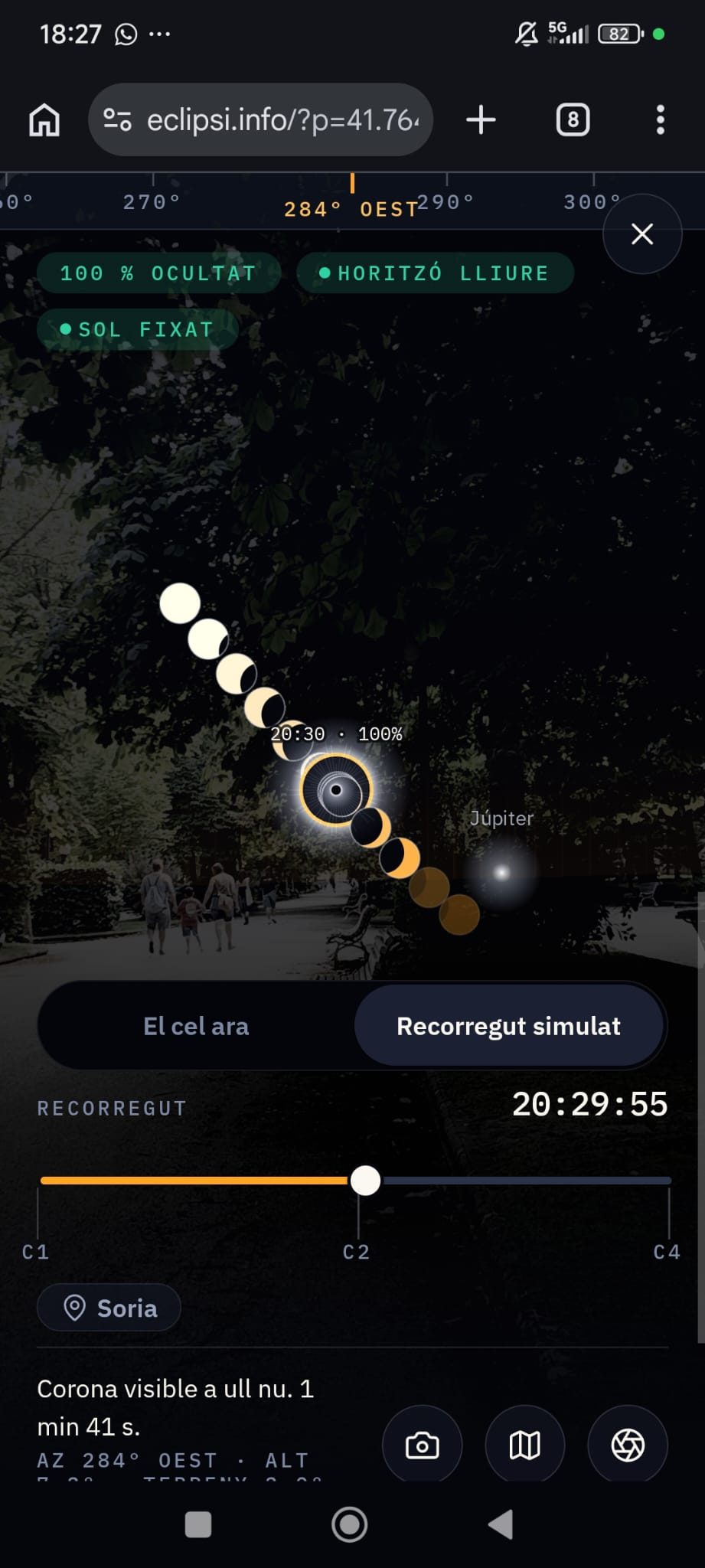
eclipsi.info lets you choose any location and calculates the eclipse based on those coordinates. It combines the location, altitude, and horizon profile to show when the eclipse will begin, which direction to look, what percentage of the Sun will be covered, and how many seconds it will be visible above the terrain.
The idea came from a personal question: whether the eclipse would be visible from home. Existing tools showed the path of totality, but didn’t tell you if a mountain would block the Sun. We turned that question into a product that anyone can use right in their browser.
A camera to help you know where to look
The camera view superimposes the Sun’s path and the phases of the eclipse onto the landscape. Before deciding on a location, you can check whether the path passes between buildings, over a mountain, or right behind an obstacle.
There’s also minute-by-minute simulation, a countdown, voice alerts, comparisons of official waypoints, lookouts, and beaches, and a cloud forecast when the date is close enough.
Designing also means knowing when to say no
In a product designed for solar observation, the interface cannot simply be limited to looking nice. The guide follows a prudent rule: it never advises removing the filter during a partial phase or when the calculated totality is too short or obscured by the terrain.
Calculations are performed on the device. No account is required, there are no ads or tracking, and the website can be installed as a PWA to keep essential data on hand in case of a service outage.
Open for 2026, 2027, and 2028
The tool is available in Catalan and Spanish and is set up for the eclipses of 2027 and 2028. The results have been cross-checked against reference data from the IGN and NASA. The code is open source so that it can be reviewed and improved.
Update. The eclipse has been and gone, and we have the numbers: 50,899 unique visitors on the 12th, 29 press pieces and a peak of 570,865 requests in one hour. We break it all down in this other article.